Just A Coincidence
For more than 30 years, Evan Janovitz has had liver disease, but has never had a single symptom. His physicians would often encourage him to lose weight and take better care of his health, though that message did not sink in until ten years ago when Evan had a coronary event and had a stent inserted into his artery. The health scare prompted him to see a liver specialist, and only through lab tests was it revealed that he had non-alcoholic steatohepatitis, better known as NASH.
Five years later, despite having no new symptoms, Evan learned that this silent disease progressed to cirrhosis, which is late-stage scarring of the liver.
“I realized at that time, I can’t put any more pressure on my liver,” says Evan.
Professional Turns Personal
For Evan, a scientist working in discovery at Bristol-Myers Squibb, his professional path became personal when he began researching treatment options in the area of fibrosis, including NASH.
“The impetus for our company to work on a silent disease, like NASH, is to halt the progression to liver cancer or the need for a liver transplant,” Evan says.
Still, Evan says it’s his love of science–not necessarily his personal health–that motivates his pursuit of drug discovery.
“This unusual circumstance is just a coincidence,” says Evan. “I’m not in my field for personal motivations. I’m more interested in the science and where it might lead us.”
Currently, there’s no treatment for NASH. The course of disease can be very long with no symptoms.
Evan’s condition has fortunately been stable for years, but that does not mean the disease is not progressing. “My life illustrates the biggest challenge with NASH,” says Evan. “At Bristol-Myers Squibb, we’re learning more about liver disease every day, but the more you learn the more you realize how complicated it is.”
Despite a lack of available treatment, Evan knows first-hand that abstaining from alcohol, restricting caloric intake, and increasing exercise are all factors in slowing down the progression of NASH. Changing his lifestyle has given him more energy and motivation to go to work and tackle the giant challenge he and so many others face.
“I’m grateful to come to work every day with a great group of scientists working together to solve one of the great medical mysteries,” Evan says.
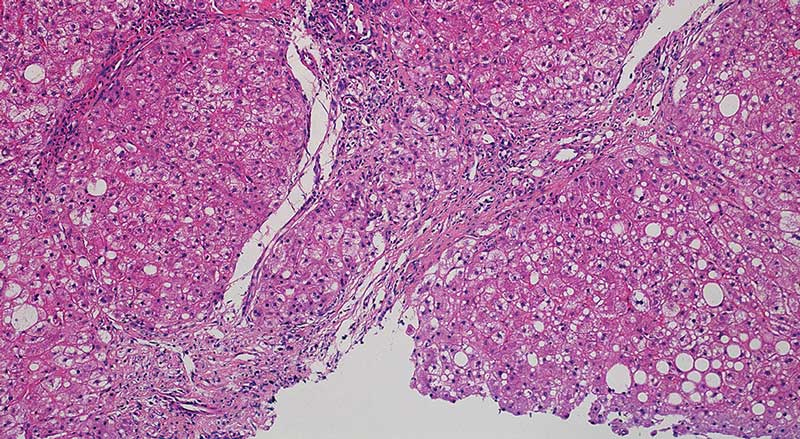
Evan studies the pathology of liver biopsies to help identify potential pharmacologic options for treating patients with NASH and liver fibrosis.